Thought Leadership
Stephen Phinney, MD, PhD; Jeff Volek, PhD; Rich Wood, PhD; Brittanie Volk, PhD, RD
Getting It Right: A Dietary Fat Strategy For Sustainable Therapeutic Ketosis
09-21-2026
●
15 min read
Introduction
On its surface, the instructions for a ketogenic diet look pretty simple: (1) reduce carbohydrates enough to allow your liver to make ketones — typically less than 50 grams per day as total carbs, (2) maintain your protein intake based on height and gender in the range of 1.5–2.0 grams per kg of reference body weight — translating to about 15% of your daily energy expenditure, and (3) eat fat to satiety — i.e., so that when you finish each meal you are not feeling hungry. Tracking your total carbs and protein intakes in grams per day is pretty straightforward. This dietary fat instruction, on the other hand, looks simple; but many people find it confusing, if not downright scary. For those who have struggled with portion-controlled “balanced diets” — i.e., stopping eating each meal when you’ve reached your allotted calories — the usual experience is that hunger isn’t satisfied or returns promptly after an hour or two. So how do you not gain weight, let alone lose weight, when our instructions allow you to eat unlimited amounts of fat while tracking only carbs and protein?
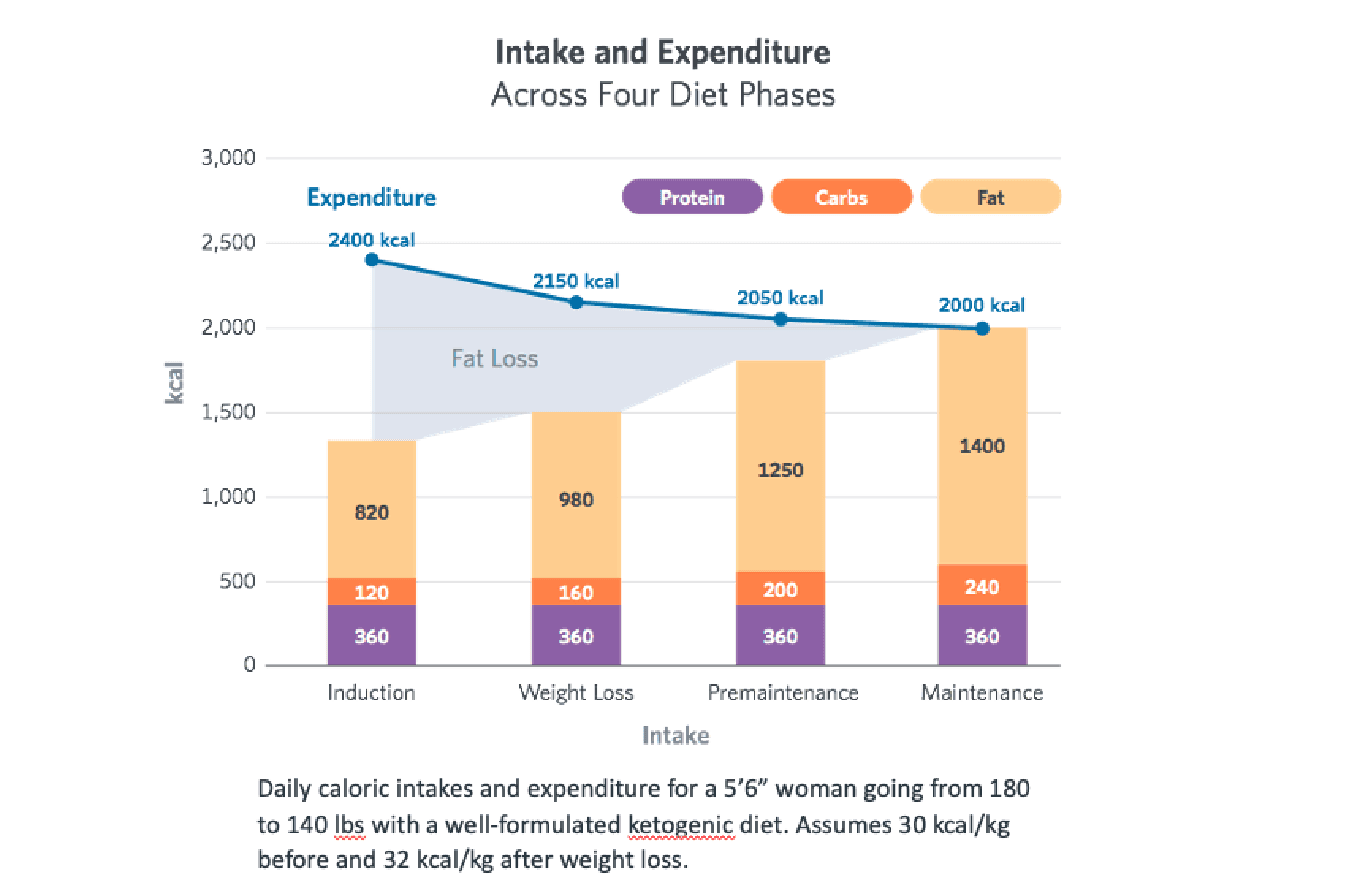
Figure 1
How macronutrient ratios change as a patient, following her “metabolic compass,” on a WFKD eats fat to satiety and arrives at a new stable maintenance weight after 8–12 months with a 40 lb weight loss. Note that while protein in grams remains the same at 90 g/day, its “macro” percentage of intake drops from 28% to 18%.
Tracking your total carbs and protein intakes in grams per day is pretty straightforward. This dietary fat instruction, on the other hand, looks simple; but many people find it confusing, if not downright scary. For those who have struggled with portion-controlled “balanced diets” — i.e., stopping eating each meal when you’ve reached your allotted calories — the usual experience is that hunger isn’t satisfied or returns promptly after an hour or two. So how do you not gain weight, let alone lose weight, when our instructions allow you to eat unlimited amounts of fat while tracking only carbs and protein?
The answer is that there is a fundamental difference between depending on carbohydrates to feed your hungry brain versus giving your body permission to burn fat and make ketones to meet most of your daily energy needs, including the 600 calories your brain burns every day. This process, called keto-adaptation, takes a week or two to get started, but then ketogenesis has equal access to both the fat you are eating plus the body fat you have in storage. In which case, your brain and other vital organs have a sustained fuel supply, so energy emergencies due to low blood sugar from running out of carbs — what runners call “hitting the wall” — are no longer an issue.
Sidebar
Why define and track a WFKD in grams per day of carbs and protein rather than “macros”? Why use individualized, easily measurable doses of just two macronutrients rather than calculating percentages of carbs, protein, and fat? Answer: because macronutrient percentages change markedly across the four phases of the typical person’s first year on a WFKD, whereas the patient’s daily targets for protein and carbohydrate in grams per day change little, if at all.
The changes in one’s metabolism associated with keto-adaptation go a lot deeper than just providing ketones to feed the brain.
But the net effect that most people experience is a reduction in compelling hunger and food cravings — also known as “food noise” — along with a prompt feeling of satiety when eating meals with little carbohydrate and most of the energy coming from fat.
Also of note, this meal-induced satiety is not one of discomfort, such as commonly occurs with GLP-1RA drugs like Wegovy and Zepbound, but a sense of comfortable satisfaction that can last for hours until the next meal.
Sidebar
Introducing the Human “Metabolic Energy Compass” How can some people not count calories, eat to satiety for years and decades, and not gain much weight? The answer is that our metabolic responses to food — how much we eat and how rapidly we burn it for energy — are individual characteristics and, to a great extent, genetically determined. The good news is that to some degree most of us have this metabolic compass, but many of us lose it when exposed to highly processed foods dominated by refined starches and sugars, and potentially the wrong kinds of fat. This situation manifests as “dietary carbohydrate intolerance,” which leads to type 2 diabetes, metabolic syndrome, and increased inflammation. But we now have real-world evidence that we can recover our metabolic compass by reducing dietary sugars and carbs below the levels that make us vulnerable. This essentially requires that we meet most of our daily energy needs from the right kinds of fat and the ketones we can make from it.
The many roles of dietary fats – they are not just ‘empty calories’!
It is true that the eventual fate of almost all of the fat that we eat is to be “burned” — technically oxidized — in our cells to produce energy. But in the process of being digested, circulated in the bloodstream, absorbed into cells to be stored or used for immediate energy, it also has many other functions in the body. Some fats have essential roles in the structure and functions of every cell in our body — specifically, the omega-6 and omega-3 essential fatty acids. Some fat is structurally modified to better suit the body’s needs for specific structural or storage purposes. And some fats — particularly the unsaturated fatty acids with one or more double bonds — are susceptible to attack by oxygen free radicals. This process, called oxidative stress, yields compounds that can have a wide variety of effects: some positive, but many negative, on cellular health and function.

Among the fats that we eat, those with two or more double bonds — particularly the polyunsaturated fatty acids in the omega-6 and omega-3 categories — are the most susceptible to oxidative stress, forming peroxides that can promote inflammation.Thus, these two categories of essential fatty acids, which we need to maintain a host of normal body functions, are also targets of oxidative stress and can contribute to the inflammation that is linked to many illnesses and aging.This brings us to a fundamental question that has been debated within the academic nutrition community since the 1970s:How much of each category do we need for optimum health, and is there a risk of getting too much of either?
The answer is: this question is still hotly debated, with strong opinions on either side.
Part of the reason that this question is still controversial is that the two categories of essential fatty acids can have opposing metabolic effects. So it is not just about how much of either one, but also about how to keep the two of them in balance.Another reason is that whether the effect appears to be good or bad depends upon what indicator of health you are looking at.For example, if you are looking at LDL cholesterol — the so-called “bad” cholesterol — eating a high proportion of omega-6 polyunsaturates will make it go down.But if the indicator in question is inflammation, a high proportion of omega-6 polyunsaturates has been linked to making inflammation go up.
And then there is saturated fat.A high intake makes LDL cholesterol go up, but a similar high saturated fat intake also makes HDL cholesterol — the so-called “good cholesterol” — go up as well.The “saturated fat is bad” debate began in the 1950s with the initiation of an international study of the diets and health statistics in 22 countries. For a number of reasons, this study was pared down over a decade to just seven countries, with the eventual publication of The Seven Countries Study.(Keys 1984).
What is also important to understand is that this debate has been going on in the context of the 1980 USDA Dietary Guidelines and subsequent iterations thereof, which advised us all to reduce total dietary fat to less than 30% of our energy intake, with more than half of our energy coming from carbohydrates. So in this high-carb, low-fat dietary world, if a person eating a 25% fat diet consumes half of it as polyunsaturates, they would be getting about 12% of their daily energy from “polys.” And if this 12% were divided as two-thirds omega-6 and one-third omega-3, that 8%/4% ratio would, in these authors’ opinion, be a pretty good balance of these two essential fatty acid categories.
To the extent that there is agreement on dietary requirements for these two classes of essential fatty acids, this balance between them should be no more than a 5:1 ratio of omega-6 to omega-3, and maybe as low as 2:1.But understand, this is not just about the ratio between these two. It is also about the total amount of polyunsaturates entering the body, expressed in grams per day, and the cumulative oxidative stress compounds that they might produce. Again, there remains considerable debate as to the optimum intakes of omega-6 and omega-3, but minimum amounts in the range of 5–10 grams per day of each are adequate to avoid deficiency in either one. Thus, in the example of an individual eating 2,200 calories per day with 25% fat that is half polyunsaturates, that 8% omega-6 translates to 20 grams per day, and the 4% omega-3 is 10 grams, which is more than adequate as long as the omega-6 to omega-3 balance is maintained. (see Table 1 below).
Dietary fats with a WFKD – looking from the flip-side perspective
For an overweight person who has adopted a WFKD and stuck with it for a year, they typically lose 10–20% of their initial weight before transitioning to a stable lower body weight. This means that they are now in energy balance and burning as many calories as they are eating. In most cases, to sustain the associated health benefits of therapeutic ketosis, they need to be eating 75–80% of their daily energy intake as fat. And here’s the punch line: if they maintained the currently recommended dietary fat choices at 50% polyunsaturates as discussed above, the omega-6 and omega-3 fatty acids would now provide close to 40% of their daily energy rather than the 12% that came with the USDA Guidelines low-fat diet. Is this good or bad?
Hint
80% of 2200 kcal/d is 1760 kcal, which translates to 196 g of fat. If this in turn is 50% polyunsaturates, at the above ratios that’s 98 g/d total polyunsaturated fat providing 65 grams of omega-6 and 32 grams of omega-3
To help answer this question, here are a few background facts about the weight-maintenance keto-adapted state that can be sustained — if done correctly — for years and decades after that first transition year.
• Keto-adaptation enables the body to double its rate of burning fat for fuel during rest and exercise.
• Inflammation, as measured by multiple biomarkers, is dramatically reduced and remains reduced as long as a WFKD is sustained. These human studies involved patients who were counselled to avoid high omega-6 seed oils while on the WFKD.
• Oxidative stress is reduced due to epigenetic effects of the ketone beta-hydroxybutyrate at levels achieved with a WFKD.
• Despite eating much greater amounts of saturated fat compared to that provided with a “balanced diet,” blood levels of saturated fats during a WFKD are sharply reduced in patients with metabolic syndrome and type 2 diabetes.
• Blood LDL cholesterol responses are variable between individuals, some rising and some falling. But in studies that assess LDL particle size, the uniform response to a WFKD is toward larger LDL particles. This larger LDL pattern is strongly associated with less cardiovascular risk.
• Blood HDL cholesterol rises and stays up on a WFKD.
• Blood triglycerides — which are typically elevated in people with insulin resistance, type 2 diabetes, and metabolic syndrome — are dramatically reduced with the transition to a WFKD.
Fatty acid intakes by class with maintenance and hypocaloric diets
To summarize this discussion up to this point, dietary fatty acids have a range of chemical structures that define their physiological functions across a spectrum from energy substrates to essential structural and signaling roles required for normal metabolism and wellbeing. Before the commercialization of high-polyunsaturated seed oils in the last century, the majority of the fatty acids we consumed and used for energy were the saturated and monounsaturated categories consumed from animal sources, or the same fatty acids made by the liver from dietary carbohydrates. And because we can make these saturated and monounsaturated fatty acids from carbohydrates, they are appropriately classed as “non-essential.”
So coming back to the question of how much polyunsaturated fat intake is too much, there remains considerable debate over the risks and benefits of both classes, but particularly for omega-6s due to their potential contribution to excess inflammation. As noted above, 30 grams per day divided as two-thirds omega-6 and one-third omega-3 is very likely enough to cover their essential functions. And given that both, particularly the omega-3s, are prone to peroxidation both during cooking and while circulating in the body, more omega-3 is not necessarily better.
Diet Type
Kcal
Total Fat
Total saturates + Monos
Key Features
g
g
%
%
g/d
%
g/d
Balanced Hypo
1500
25
50
21
50
21
Balanced Hypo
1500
25
75
31
25
10
Balanced Main
2200
25
50
31
50
10
Balanced Main
2200
25
75
46
25
15
WFKD Hypo
1500
80
50
67
50
67
WFKD Hypo
1500
80
75
99
25
33
WFKD Main
2200
80
50
98
50
98
WFKD Main
2200
80
75
146
25
49
Example energy intakes: Main = maintenance energy intake, Hypo = 700 kcal/day caloriedeficit. Highlighted: Note high levels of total polyunsaturated intakes, even when only 25%of dietary fat is polyunsaturated.
And this is where choosing the right fat sources for a well-formulated ketogenic diet becomes a challenge. Specifically, to keep one’s total polyunsaturate intake close to 30 grams per day during long-term maintenance on a 75–80% fat WFKD, the proportions of polyunsaturates compared to saturates plus monounsaturates need to be kept at or under 25%. Note that a maintenance WFKD using 25% polyunsaturates still delivers 49 grams per day. Thus, during the maintenance phase of a WFKD, getting down to or even below 50 grams per day of total polyunsaturates can become a dietary gauntlet. Why this is a challenge becomes clear if we look at the fatty acid composition of the most common sources of dietary fat. In the top half are seed oils, and most of them have very high levels of omega-6 fatty acids, and little if any omega-3s. Interestingly, standard canola oil is the only one that has a moderate level of omega-6 plus a reasonable level of omega-3. Two other points of interest are the “HO” versions of sunflower, soybean, safflower, and canola oils. These have much higher contents of monounsaturated fats — also known as high oleic — and much less omega-6 polyunsaturates, making them more like olive oil and thus useful in keeping total omega-6 intake reasonable. However, these HO oils are relatively new and only slowly becoming available in retail fat sources like salad dressing and mayonnaise.
The other point of interest is the composition of the body fat that we humans store as our reserve fuel. This consists predominantly of saturates and monounsaturates, despite the increasing dominance of soybean, corn, and safflower oils in our food supply over the last four decades. This may be due to the contribution of saturated and monounsaturated fats produced via de novo lipogenesis by individuals eating carbohydrate in excess of their ability to oxidize it directly — i.e., exceeding the individual’s personal threshold of carbohydrate tolerance. But it may also be influenced by preferential oxidation of polyunsaturates, particularly the predominant omega-3 fatty acid alpha-linolenate. The most striking contrast in human adipose fatty acid content is the 18% omega-6 linoleate versus the 1% omega-3 alpha-linolenate. This dramatic imbalance between the primary dietary omega-6 fatty acid compared to its omega-3 counterpart supports the goal of keeping omega-6 polyunsaturated intake very modest while including available omega-3 sources when consuming a WFKD.

Figure 3
Practical Guide to Fat Choices with a WFKD
• Don’t avoid, and maybe even prioritize, animal fats when on a WFKD.
• Use high-monounsaturated fat sources, such as olive oil, canola oil, high-oleic oils, and foods prepared with them.
• Avoid using standard canola oil for frying or high-temperature cooking to prevent damaging its beneficial omega-3 content.
• Be cautious about routinely eating prepared foods for which the fat source is not clearly defined.
• Be prepared to negotiate the source and amounts of fat in meals ordered in restaurants.
• In some cases, bring your own fat to achieve your satiety goal — for example, a small bottle of olive, canola, or avocado oil.
• One ounce of oil can be easily carried and provides about 225 calories when added to a salad. • Alternatively, ask for four pats of butter, which provides about 150 calories, to go with your entrée.
• Hint: politely send the free bread back, but keep the butter.
• Eating cold-water ocean fish two to three times per week provides a meaningful foundation for omega-3 fatty acid intake, but this is best done in combination with lowering total omega-6 fatty acid intake.
• On a cost basis, canola oil is a more economical source of omega-3 fat while reducing omega-6 intake.

References
Aarsland A, Wolfe RR. Hepatic secretion of VLDL fatty acids during stimulated lipogenesis in men. Journal of Lipid Research. 1998;39:1280–1286.
Athinarayanan SJ, Adams RN, Hallberg SJ, et al. Long-term effects of a novel continuous remote care intervention including nutritional ketosis for the management of type 2 diabetes: a 2-year non-randomized clinical trial. Frontiers in Endocrinology. 2019 Jun 5;10:450805.
Athinarayanan SJ, Phinney SD, Adams RN, Volek JS, Thurmond DC, McKenzie AL, Roberts CG, Ratner RE, Krauss RM, Fonseca VA. Broad-Spectrum Effects of Carbohydrate Reduction on Inflammatory and Immune Mediators in Type 2 Diabetes. Endocrine Research. 2026 Apr 3;51(2):100–116.
Bouchard C, Tremblay A, Després JP, Thériault G, Nadeauf A, Lupien PJ, Moorjani S, Prudhomme D, Fournier G. The response to exercise with constant energy intake in identical twins. Obesity Research. 1994 Sep;2(5):400–410.
Cahill Jr GF. Fuel metabolism in starvation. Annual Review of Nutrition. 2006 Aug 21;26(1):1–22.
Creighton BC, Hyde PN, Maresh CM, Kraemer WJ, Phinney SD, Volek JS. Paradox of hypercholesterolaemia in highly trained, keto-adapted athletes. BMJ Open Sport & Exercise Medicine. 2018 Oct 4;4(1).
DeLany J, Windhauser M, Champagne C, Bray GA. Differential oxidation of individual dietary fatty acids in humans. American Journal of Clinical Nutrition. 2000;72:905–911.
Forsythe CE, Phinney SD, Fernandez ML, Quann EE, Wood RJ, Bibus DM, Kraemer WJ, Feinman RD, Volek JS. Comparison of low-fat and low-carbohydrate diets on circulating fatty acid composition and markers of inflammation. Lipids. 2008 Jan;43(1):65–77.
Hyde PN, Sapper TN, Crabtree CD, LaFountain RA, Bowling ML, Buga A, Fell B, McSwiney FT, Dickerson RM, Miller VJ, Scandling D. Dietary carbohydrate restriction improves metabolic syndrome independent of weight loss. JCI Insight. 2019 Jun 20;4(12):e128308.
Innes JK, Calder PC. Omega-6 fatty acids and inflammation. Prostaglandins, Leukotrienes and Essential Fatty Acids. 2018 May 1;132:41–48.
Keys A, Menotti A, Aravanis C, Blackburn H, Djordevič BS, Buzina R, Dontas AS, Fidanza F, Karvonen MJ, Kimura N, Mohaček I. The Seven Countries Study: 2,289 deaths in 15 years. Preventive Medicine. 1984 Mar 1;13(2):141–154.
Krauss RM. Dense low-density lipoproteins and coronary artery disease. The American Journal of Cardiology. 1995 Feb 23;75(6):53B–57B.
Lands WE. Dietary fat and health: the evidence and the politics of prevention. Annals of the New York Academy of Sciences. 2005 Dec;1055(1):179–192.
NIH 2025. Omega-3 Fatty Acids — Health Professional Fact Sheet. https://ods.od.nih.gov/factsheets/Omega3FattyAcids-HealthProfessional/
Phinney SD, Horton ES, Sims EA, Hanson JS, Danforth E, Lagrange BM. Capacity for moderate exercise in obese subjects after adaptation to a hypocaloric, ketogenic diet. The Journal of Clinical Investigation. 1980 Nov 1;66(5):1152–1161.
Phinney SD, Bistrian BR, Evans WJ, Gervino E, Blackburn GL. The human metabolic response to chronic ketosis without caloric restriction: preservation of submaximal exercise capability with reduced carbohydrate oxidation. Metabolism. 1983 Aug 1;32(8):769–776.
Phinney SD, Davis PG, Johnson SB, Holman RT. Obesity and weight loss alter serum polyunsaturated lipids in humans. The American Journal of Clinical Nutrition. 1991 Apr 1;53(4):831–838.
Ravussin E, Lillioja S, Knowler WC, Christin L, Freymond D, Abbott WG, Boyce V, Howard BV, Bogardus C. Reduced rate of energy expenditure as a risk factor for body-weight gain. New England Journal of Medicine. 1988 Feb 25;318(8):467–472.
Shimazu T, Hirschey MD, Newman J, He W, Shirakawa K, Le Moan N, Grueter CA, Lim H, Saunders LR, Stevens RD, Newgard CB. Suppression of oxidative stress by beta-hydroxybutyrate, an endogenous histone deacetylase inhibitor. Science. 2013 Jan 11;339(6116):211–214.
Stunkard AJ, Harris JR, Pedersen NL, McClearn GE. The body-mass index of twins who have been reared apart. New England Journal of Medicine. 1990 May 24;322(21):1483–1487.
Tremblay A, Poehlman ET, Després JP, Theriault G, Danforth E, Bouchard C. Endurance training with constant energy intake in identical twins: changes over time in energy expenditure and related hormones. Metabolism. 1997 May 1;46(5):499–503.
Volek JS, Phinney SD. The Art and Science of Low Carbohydrate Living. New York, USA: Beyond Obesity. 2011:1–97.
Volek JS, Freidenreich DJ, Saenz C, Kunces LJ, Creighton BC, Bartley JM, Davitt PM, Munoz CX, Anderson JM, Maresh CM, Lee EC. Metabolic characteristics of keto-adapted ultra-endurance runners. Metabolism. 2016 Mar 1;65(3):100–110.
Wood RJ, Volek JS, Liu Y, Shachter NS, Contois JH, Fernandez ML. Carbohydrate restriction alters lipoprotein metabolism by modifying VLDL, LDL, and HDL subfraction distribution and size in overweight men. The Journal of Nutrition. 2006 Feb 1;136(2):384–389.
Youm YH, Nguyen KY, Grant RW, Goldberg EL, Bodogai M, Kim D, D’Agostino D, Planavsky N, Lupfer C, Kanneganti TD, Kang S. The ketone metabolite beta-hydroxybutyrate blocks NLRP3 inflammasome-mediated inflammatory disease. Nature Medicine. 2015 Mar;21(3):263–269.
Contact Us
952 School Street, Suite 212
Napa, CA 94559