MODULE 2
Prescribing the Well-Formulated Ketogenic Diet
Learning Objectives
Determine the amounts and timing of individualized macronutrient targets to support a WFKD
Explain the critical importance of adequate — not excessive — protein intake
Calculate and prescribe individually appropriate sodium, potassium, and magnesium intakes
Counsel clients on the variable role of dietary fat and prevent common prescription errors
Design and communicate a complete ketogenic prescription for a new client
In this module
SECTION 2.1
The Carbohydrate Threshold
The foundational prescription parameter of any ketogenic diet is carbohydrate restriction sufficient to suppress insulin and induce hepatic ketogenesis. The varying threshold for therapeutic ketosis in most adults is 20–50 grams of total carbohydrate per day, though individual variation is substantial. For clinical implementation with metabolically compromised patients, default to total carbohydrate counting rather than net carbohydrate, as the latter may underestimate available glucose.
Individual Variation in the Carbohydrate Threshold
The carbohydrate threshold for nutritional ketosis is not a fixed number but a biological variable influenced by degree of insulin resistance, body composition, physical activity level, medications, stress, and sleep quality. Furthermore, a patient’s carbohydrate tolerance may increase somewhat with weight loss as underlying insulin resistance and inflammation improve.
Patients are typically started between 30g and 50g total carbohydrate/day, using the lower value for patients with significant metabolic impairments (e.g., type 2 diabetes, pre-diabetes, metabolic syndrome). Finger-stick blood values for BHB > 0.5 mM (the lower threshold for nutritional ketosis) should be achieved within 7-10 days. If not, the patient should be coached to carefully track the total grams of carbohydrate per day, which may need to be adjusted lower. Figure 2.1 was designed to depict the wide variability in carbohydrate intake threshold to reach nutritional ketosis, and the numerous factors that impact that number. Of note, this figure is designed to depict the concept and frequency of occurrence, based on three different reference populations, and the curves are based upon standard deviations from the mean.

Bell curve illustrating the range of individual carbohydrate thresholds for nutritional ketosis (approximately 20–75g/day) and factors that shift the threshold.
SECTION 2.2
Protein Adequacy: The Non-Negotiable Macronutrient
Why Protein Cannot Be Compromised
Among the three prescription parameters of the WFKD, protein adequacy is commonly incorrectly prescribed. Insufficient dietary protein on a ketogenic diet results in protein catabolism (Hoffer 1984). The clinical consequences include progressive lean mass loss, weakness, fatigue, functional decline, increased hunger, and impaired immune function. Protein adequacy is also a component of satiety (Layman 2009). On the opposite end of incorrect protein prescription is the misconception that a WFKD is “high-protein”, which it is not. It is entirely possible – and even likely – that people over-consume protein when not guided properly and influenced by poorly-informed sources. Let’s spend time on how to properly home in on an individual patient’s protein prescription.
Calculating the Protein Target
The critical methodological point is that protein should be calculated based on reference body weight, NOT actual body weight in obese individuals. Using actual body weight in severe obesity would significantly overprescribe protein and overshoot the needs of metabolically active tissue.
Reference Body Weight Calculation
Devine Formula:
Male: 50 kg + 2.3 kg per inch over 5 feet
Female: 45.5 kg + 2.3 kg per inch over 5 feet
Clinical Population
Protein Target
Sedentary adults, weight loss
1.2–1.5 g/kg reference body weight/day
Active adults, moderate exercise (<5 hrs/week)
1.5–2.0 g/kg reference body weight/day
Athletes, high exercise volume (>5 hrs/week)
2.0–2.2 g/kg reference body weight/day
Older adults (>65 years)
1.5–2.0 g/kg reference body weight/day; err toward higher end to mitigate sarcopenia risk
Clinical Pitfall: Low-Protein Ketogenic Diets
Some popular ketogenic approaches prescribe protein as a fixed macronutrient at 10–15% of calories. Most overweight patients spontaneously under-eat by 1000 kcal/day or more when stating a WFKD. 10-15% of 1500 kcal is a lot less protein than the same ‘macro’ % at 2500 kcal. This can create a protein-insufficient state that risks muscle catabolism, particularly in older adults and patients undergoing significant weight loss. A WFKD optimizes metabolic outcomes by prescribing protein and carbohydrates in grams per day rather than macronutrients percentages. Set protein at grams per day first, adjust carbohydrates in grams per day to enable nutritional ketosis, and let fat eaten to satiety supply the remaining energy need.
SECTION 2.3
Fat: The Variable Macronutrient
After establishing protein and carbohydrate targets, dietary fat becomes the variable that determines total energy intake. The amount of fat that a patient consumes in a WFKD is not prescribed as a target to be met regardless of hunger; it is eaten to satiety, with intake naturally adjusting across phases of the dietary intervention.

Use existing figure
Fat as the Energy-Regulating Variable
The body has two potential sources of fat to fuel ketogenesis: exogenous dietary fat and endogenous adipose fat. The proportion used should vary depending on the therapeutic goal:
Weight loss phase: Caloric deficit is desired., and is achieved during a WFKD not by calculating and prescribing kcal intake, but by instructing the patient on appropriate carbohydrate and protein intake, with fat to satiety. This should initially result in fat intake being moderate — sufficient to satisfy hunger while allowing adipose stores to provide a meaningful fraction of daily energy. Encouraging fat intake beyond satiety eliminates the natural caloric deficit typical of the early phases of a WFKD and stalls weight loss.
Maintenance phase: Over a period of 6-12 months on a WFKD, most overweight patients experience a slowing in their rate of weight loss as they approach a new lower stable weight. This occurs naturally as satiety increases dietary fat intake to match total energy expenditure, and adipose stores are no longer being mobilized for fuel.
Critical Counseling Point: The "Fat Bomb" Error
A common error in popular ketogenic communities is the prescription of excessive dietary fat — "fat bombs," MCT oil in every beverage, cream in multiple coffees — with the belief that more fat means more ketones and faster results. For weight-loss patients, this is counterproductive. Dietary fat and body fat are metabolically equivalent contributors to ketosis. A patient who is overweight has abundant endogenous fat stores. Adding dietary fat beyond satiety replaces body fat mobilization with exogenous fat oxidation — the patient treads water calorically. Counsel clients to eat fat to satiety — satisfying hunger fully, but encouraging intake beyond satiety is counter-productive.
Fat Source Quality
While the primary prescription concern is total carbohydrate and protein adequacy, fat source quality matters for long-term metabolic health. Analysis of human adipose tissue reveals a composition dominated by MUFA and SFA, with subcutaneous and visceral fat differing in their SF:MUFA ratio — suggesting an evolutionary preference for these fat classes (Pezeshkian 2009). High-omega-6 seed oils represent an evolutionarily novel dietary component: no traditional human culture derived the majority of its fatty acid intake from that found in most industrially processed seed oils, and modern consumption levels are estimated to be 15–20 times higher than ancestral levels (Simopoulos 2002). With the WFKD, it is recommended to encourage monounsaturated and saturated sources of fat and limiting highly unsaturated omega-6 fat sources. For a deeper-dive on this topic please see our {THOUGHT LEADERSHIP PIECE – WHEN READY}.
Figure 2.3 was designed to compare the typical composition of human adipose tissue – with respect to fatty acid profile – with the dietary fatty acid consumption with the typical Western diet. Figure 2.4 was designed to provide an overview of the fatty acid composition of different fat sources.

Pie chart: human adipose tissue fatty acid composition (MUFA ~50%, SFA ~40%, PUFA ~10%). Contrast with typical high-seed-oil Western diet fatty acid profile.

Fatty acid types composing common sources of dietary fat.
SECTION 2.4
Electrolyte Management: The Cornerstone of Successful Adaptation
Inadequate electrolyte management is a common cause of preventable ketogenic diet failure. Most “keto flu” symptoms are not intrinsic to ketosis — they are symptoms of iatrogenic electrolyte depletion secondary to the renal effects of carbohydrate restriction (Phinney 1983b, Volek 2012).
The Mechanism: Renal Sodium Handling in Ketosis
As dietary carbohydrate drops and insulin falls, the sodium-retaining signal to the renal tubule disappears. The kidney increases urinary sodium excretion, producing 1–5 kg of fluid loss within the first week, depending on the level of excess fluid retention. Additionally, ketone bodies are excreted as potassium and sodium salts in urine, further increasing cation losses. This process is called the ‘natriuresis of fasting’ (Sigler 1975) and is directly linked to blood ketone levels. Without deliberate electrolyte replacement, the result is clinically symptomatic depletion states for sodium, potassium, and sometimes magnesium. Of note, symptomatic sodium and magnesium depletions can frequently occur despite blood levels remaining within the normal range.

Diagram of renal sodium handling: insulin-driven Na+ reabsorption in the fed state (left panel) vs. low-insulin natriuresis and ketone-salt urinary loss in ketosis (right panel).
Sodium: The Most Critical Electrolyte
Parameter
Sodium Guidance
Target intake
2,500-4,000 mg/day during initial adaptation, potentially more in hot climates or heavy sweating (Phinney 1983b, O’Donnell 1014)
Sources
Salted broths (bouillon, bone broth), moderately salting foods, unsweetened pickle, olives, salt tablets, sugar-free electrolyte supplements
Timing
Distributed throughout the day; particularly important at breakfast and pre-exercise
Caution
Patients with heart failure, hypertension on medications, or Stage 3-4 CKD require physician-directed sodium guidance
Potassium: The Intracellular Electrolyte
Dietary potassium depletion on a ketogenic diet is well-documented and clinically relevant (Stone et al. 2016). A critical practical point: bacon and cured meats — common WFKD staples — are brined in sodium-heavy solutions that are potassium-depleted. For example, three slices of bacon provide approximately 135 mg potassium, less than 4% of the daily target. Clients relying heavily on processed meats must compensate with potassium from foods (e.g., avocado, leafy greens) or supplemental sources such as Lite Salt (a balanced mix of potassium chloride and sodium chloride). Of note, the above isn’t intended to recommend a heavy reliance on processed meat, only that many people gravitate toward that path. Proper guidance from the Registered Dietitian or other behavior change professional is required to help people understand the tremendous variety that is available in this dietary approach.
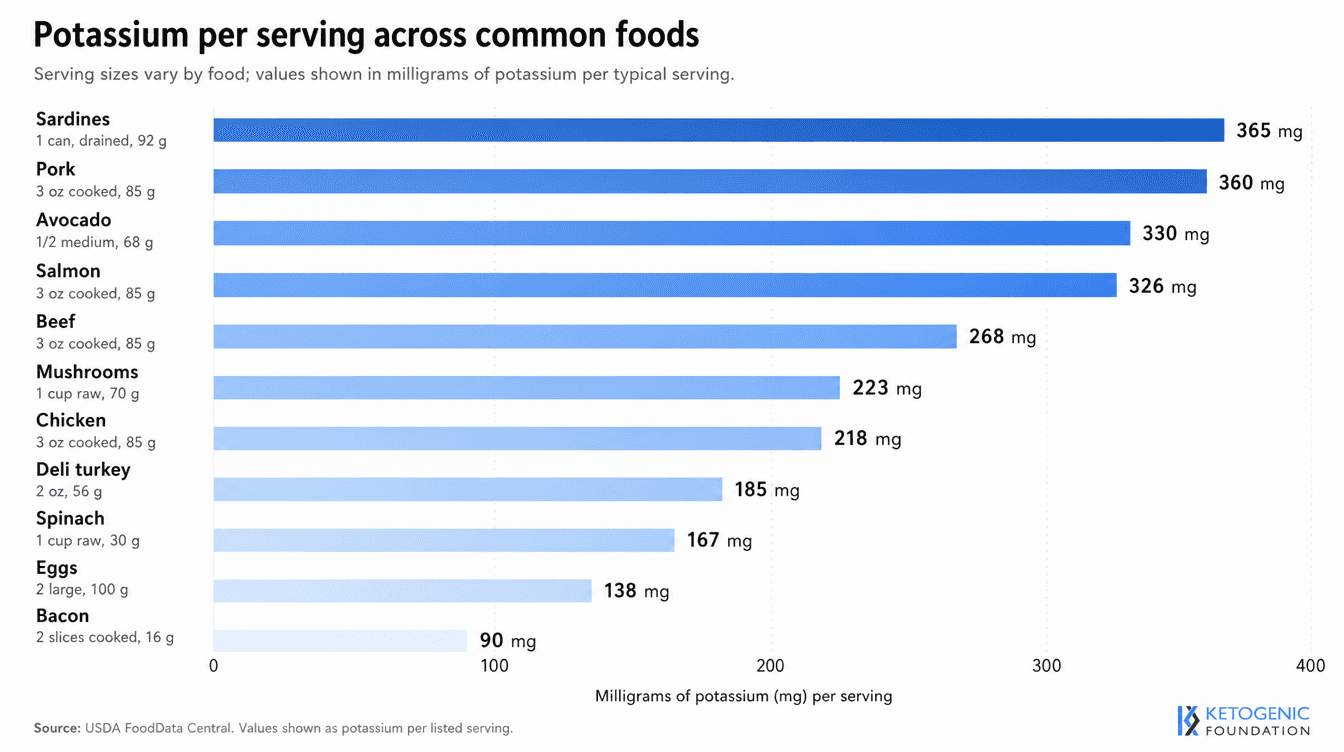
Bar chart: potassium content per 100g of avocado, salmon, bacon, deli turkey, canned sardines, eggs, spinach. Illustrate the potassium poverty of processed meats vs. whole food WFKD sources.
Magnesium: The Cramp-Preventing Mineral
Magnesium is involved in over 300 enzymatic reactions, including those governing heart and neuromuscular functions, the body’s energy supply (ATP synthesis), and blood pressure regulation. Subclinical magnesium deficiency is estimated to affect 45–60% of the general population and is compounded by increased urinary losses on a ketogenic diet (DiNicolantonio 2018). Target maintenance intake is 400 mg elemental magnesium/day. If supplementation is indicated, preferred forms are magnesium glycinate or malate. Alternatively, a slow-release supplement of magnesium chloride and calcium chloride (Slow-Mag Mag-64) provides both of these minerals in readily absorbable formulation. Magnesium oxide is poorly absorbed and not recommended for electrolyte replacement.
Keto Flu" Prevention Protocol for New Clients
Begin the following protocol on Day 1 of carbohydrate restriction: SODIUM: 1-2 cups salted broth (600-800 mg/cup) daily (start Day 1); salt food to taste; add another cup of broth or 1/4–1/2 tsp salt to water if symptomatic POTASSIUM: Include potassium-rich WFKD foods daily (avocado, leafy greens, fish); consider 1/4–1/2 tsp Lite Salt if dietary potassium sources are inadequate MAGNESIUM: Magnesium: if muscle cramps occur, 2-3 Slow-Mag or Mag-64 daily until muscle cramps cease FLUID: Drink to thirst, targeting 2–3 L/day; do not restrict fluid Reassess at Week 1 check-in. Persistent symptoms after adequate electrolyte replacement should prompt assessment for other causes. Caution is advised for sodium management in patients with hypertension, congestive heart failure, or impaired renal function. For patients taking diuretic medication, before suggesting added sodium intake, the patient’s physician should consider reducing or de-prescribing the diuretic to manage ‘keto-flu’ symptoms.
SECTION 2.5
Meal replacements: do they have a place when implementing a ketogenic diet?
Commercially available ketogenic meal replacements — ready-made shakes, bars, and powdered formulas — are frequently marketed as a convenient shortcut for initiating nutritional ketosis. While these products can be convenient, people should be counseled against relying on them heavily. Several concerns underlie this position. Most formulations deliver inadequate protein relative to the gram-per-kilogram targets established earlier in this module, placing people — particularly older adults and those undergoing substantial weight loss — at risk of the lean mass catabolism that adequate protein is specifically meant to prevent. The most aggressive applications of these products, such as full meal-replacement and very-low-calorie protocols, require active medical supervision and in some cases have historically been associated with serious adverse events when used without it (Wadden 1990). Just as importantly, programs built around meal replacements perform poorly over the time horizons that matter: in practical, real-world settings, clients who lose weight on a shake-based regimen almost always regain it (Wing 1994), because the approach does not build the food-selection and meal-preparation skills that sustain a WFKD long term.
The deeper limitation is that meal replacements bypass the very behavior change this dietary approach depends on. A WFKD succeeds when a client learns to choose, prepare, and enjoy whole foods that meet their individualized protein, carbohydrate, and electrolyte needs — competencies a packaged product cannot teach. For this reason, meal replacements are best understood as an occasional supplement to real food rather than a substitute for it. Their reasonable use case is narrow: bridging a meal during travel, a demanding workday, or another situation where preparing whole food is genuinely impractical. Used this way — sparingly, and alongside an established whole-food pattern — they can support adherence. Used as the primary strategy, they undermine both the metabolic and the behavioral goals of the intervention.
Disclaimer
DISCLAIMER: This content is provided by The Ketogenic Foundation for educational and informational purposes only and does not constitute medical, nutritional, dietetic, or other professional advice. It is not intended to diagnose, treat, cure, or prevent any disease. This content does not create any professional relationship or duty of care between The Ketogenic Foundation and any reader, nor does it create or replace any practitioner–client or provider–patient relationship. Nothing in this content expands any reader's scope of practice; each professional remains solely responsible for acting within the limits of their own license, certification, credential, and applicable federal, state, and local law, and for referring to or coordinating with an appropriately licensed professional where required. Individualized clinical or nutritional decisions should be made in consultation with a qualified, appropriately licensed healthcare professional. Reliance on this content is at the user's own discretion and risk.
Module 2 — Knowledge Assessment
Answer the following questions to assess your understanding of Module 2 content.
QUESTION 1
A 45-year-old woman (5'4", actual weight 220 lbs, reference body weight ~54 kg) is beginning a WFKD for type 2 diabetes. Using a protein target of 1.5 g/kg reference body weight, what is her daily protein target?
A. 81 grams/day
B. 150 grams/day
C. 220 grams/day
D. 50 grams/day
Reveal answer
QUESTION 2
A client in a weight loss phase has been adding fat bombs, MCT oil, and liberal cream to maximize ketosis. Her weight loss has stalled. What is the most likely explanation?
A. She needs more MCT oil to achieve deeper ketosis
B. Excess dietary fat intake has replaced body fat mobilization as the fuel source, eliminating the caloric deficit necessary for weight loss; she should eat fat to satiety rather than forcing fat intake
C. Her carbohydrate intake is too low and needs to be increased
D. Stalls are expected and no intervention is needed
Reveal answer
QUESTION 3
A client reports severe nocturnal muscle cramps during Week 2. She is taking adequate sodium (5,000 mg/day) and potassium (3,500 mg/day). What is the most likely deficit and appropriate intervention?
A. Calcium deficiency; recommend dairy supplementation
B. Iron deficiency; recommend red meat increase
C. Magnesium deficiency; recommend 400–500 mg elemental magnesium (glycinate or malate form) at bedtime (DiNicolantonio et al. 2018)
D. Vitamin D deficiency; recommend supplementation
Reveal answer
QUESTION 4
Which statement about the carbohydrate threshold for nutritional ketosis is most accurate?
A. The threshold is fixed at exactly 20g/day for all individuals
B. The threshold varies among individuals based on insulin resistance severity, body composition, physical activity, and medications; begin at 20–30g and individualize (Westman et al. 2008)
C. Ketosis is determined by fat intake, not carbohydrate restriction
D. Higher physical activity always requires stricter carbohydrate restriction
Reveal answer
QUESTION 5
Why is urine ketone measurement unreliable for ongoing monitoring of nutritional ketosis beyond the first 1–2 weeks?
A. The kidneys stop filtering ketones after week 2
B. Urine ketone strips become chemically inactivated by prolonged exposure to ketones
C. As keto-adaptation proceeds, peripheral tissues increasingly utilize acetoacetate before it can be excreted, reducing urinary ketone concentrations despite maintained blood ketosis
D. BHB is converted back to acetoacetate in the urine, confounding measurements
Reveal answer
References
References
DiNicolantonio JJ, O’Keefe JH, Wilson W. Subclinical magnesium deficiency: a principal driver of cardiovascular disease and a public health crisis. Open Heart. 2018;5(1):e000668.
Hoffer LJ, Bistrian BR, Young VR, Blackburn GL, Matthews DE. Metabolic effects of very low calorie weight reduction diets. The Journal of clinical investigation. 1984 Mar 1;73(3):750-8.
Layman DK, Clifton P, Gannon MC, Krauss RM, Nuttall FQ. Protein in optimal health: heart disease and type 2 diabetes. Am J Clin Nutr. 2008;87(5):1571S-1575S.
Lenighan YM, Nugent AP, McNulty BA, et al. Predominant fatty acid intake influences the composition of the erythrocyte membrane independently of BMI. Eur J Nutr. 2019;58(6):2483-2491.
Layman DK. Dietary Guidelines should reflect new understandings about adult protein needs. Nutrition & metabolism. 2009 Mar 13;6(1):12.
O’Donnell M, Mente A, Rangarajan S, McQueen MJ, Wang X, Liu L, Yan H, Lee SF, Mony P, Devanath A, Rosengren A. Urinary sodium and potassium excretion, mortality, and cardiovascular events. New England Journal of Medicine. 2014 Aug 14;371(7):612-23.
Pezeshkian M, Noori M, Najjarpour-Jabbari H, Abolfathi A, Darabi M, Darabi M, Shaaker M, Shahmohammadi G. Fatty acid composition of epicardial and subcutaneous human adipose tissue. Metabolic syndrome and related disorders. 2009 Apr;7(2):125-32.
Phinney SD, Bistrian BR, Evans WJ, Gervino E, Blackburn GL. The human metabolic response to chronic ketosis without caloric restriction: preservation of submaximal exercise capability with reduced carbohydrate oxidation. Metabolism. 1983a;32(8):769-76.
Phinney SD, Bistrian BR, Wolfe RR, Blackburn GL. The human metabolic response to chronic ketosis without caloric restriction: physical and biochemical adaptation. Metabolism. 1983b;32(8):757-68.
Simopoulos AP. The importance of the ratio of omega-6/omega-3 essential fatty acids. Biomed Pharmacother. 2002;56(8):365-79.
Volek JS. Phinney SD. The Art and Science of Low Carbohydrate Living. Beyond Obesity LLC. 2011.
Volek JS. Phinney SD. The Art and Science of Low Carbohydrate Performance: Chapter 9. Beyond Obesity LLC. 2012.
Wing RR, Blair E, Marcus M, Epstein LH, Harvey J. Year-long weight loss treatment for obese patients with type II diabetes: does including an intermittent very-low-calorie diet improve outcome?. The American journal of medicine. 1994 Oct 1;97(4):354-62.
Westman EC, Yancy WS, Mavropoulos JC, Marquart M, McDuffie JR. The effect of a low-carbohydrate, ketogenic diet versus a low-glycemic index diet on glycemic control in type 2 diabetes mellitus. Nutr Metab (Lond). 2008;5:36.
Contact Us
952 School Street, Suite 212
Napa, CA 94559